Robot Dynamics
Overview
Robot dynamics describes the relationship between forces/torques and robot motion. It answers the question: "What joint torques are needed to produce desired motion?"
Lagrange-Euler Formulation
The Lagrangian \(L = K - P\) (kinetic energy minus potential energy) leads to:
Where: - \(M(q)\): Mass/Inertia matrix - \(C(q,\dot{q})\): Coriolis and centrifugal forces - \(g(q)\): Gravity vector - \(\tau\): Joint torques
A. Manipulator Equation of Motion
To make a robot arm move the way we want, what torques do we need at each joint?
Mathematical Formulation
The manipulator equation of motion in Lagrangian form is:
Where: - \(\tau \in \mathbb{R}^n\): Joint torque vector - \(M(q) \in \mathbb{R}^{n \times n}\): Mass/inertia matrix - \(C(q,\dot{q}) \in \mathbb{R}^n\): Coriolis and centrifugal terms - \(g(q) \in \mathbb{R}^n\): Gravity vector - \(q, \dot{q}, \ddot{q}\): Joint position, velocity, acceleration
The kinetic energy \(K\) and potential energy \(P\) are:
Where \(h_i(q)\) is the height of link \(i\)'s center of mass.
Code Implementation
import numpy as np

def compute_manipulator_equation(m1, m2, l1, l2, r1, r2, I1, I2,
                                  theta1, theta2, qd1, qd2, qdd1, qdd2,
                                  g_val=9.81):
    """
    Compute the manipulator equation of motion for a 2-DOF planar robot.

    Args:
        m1, m2: Link masses [kg]
        l1, l2: Link lengths [m]
        r1, r2: Distance from joint to COM [m]
        I1, I2: Moment of inertia about COM [kg·m²]
        theta1, theta2: Joint angles [rad]
        qd1, qd2: Joint velocities [rad/s]
        qdd1, qdd2: Joint accelerations [rad/s²]
        g_val: Gravitational acceleration [m/s²]

    Returns:
        tau: Joint torques [N·m]
    """
    # Compute inertia matrix M(q)
    M = compute_inertia_matrix(m1, m2, l1, l2, r1, r2, I1, I2, theta1, theta2)

    # Compute Coriolis and centrifugal terms C(q, qd)
    C = compute_coriolis(m2, l1, r2, theta2, qd1, qd2)

    # Compute gravity terms g(q)
    g_vec = compute_gravity(m1, m2, l1, r1, r2, g_val, theta1, theta2)

    # Manipulator equation: tau = M * qdd + C + g
    qdd = np.array([qdd1, qdd2])
    tau = M @ qdd + C + g_vec

    return tau


def compute_energy(m1, m2, l1, l2, r1, r2, I1, I2, theta1, theta2, qd1, qd2, g_val=9.81):
    """
    Compute kinetic and potential energy for a 2-DOF planar robot.

    Returns:
        K: Kinetic energy [J]
        P: Potential energy [J]
    """
    # Kinetic energy: K = 0.5 * qd^T * M(q) * qd
    M = compute_inertia_matrix(m1, m2, l1, l2, r1, r2, I1, I2, theta1, theta2)
    qd = np.array([qd1, qd2])
    K = 0.5 * qd @ M @ qd

    # Potential energy: P = m1*g*h1 + m2*g*h2
    # For link 1: h1 = r1 * cos(theta1)
    # For link 2: h2 = l1*cos(theta1) + r2*cos(theta1+theta2)
    h1 = r1 * np.cos(theta1)
    h2 = l1 * np.cos(theta1) + r2 * np.cos(theta1 + theta2)
    P = m1 * g_val * h1 + m2 * g_val * h2

    return K, P


# Example usage
if __name__ == "__main__":
    # Robot parameters
    m1, m2 = 5.0, 3.0  # kg
    l1, l2 = 1.0, 0.8  # m
    r1, r2 = 0.5, 0.4  # m (distance from joint to COM)
    I1, I2 = 0.1, 0.05  # kg·m²

    # State
    theta1, theta2 = np.pi/4, np.pi/6  # rad
    qd1, qd2 = 0.5, 0.3  # rad/s
    qdd1, qdd2 = 0.1, 0.2  # rad/s²

    # Compute torques
    tau = compute_manipulator_equation(m1, m2, l1, l2, r1, r2, I1, I2,
                                        theta1, theta2, qd1, qd2, qdd1, qdd2)

    # Compute energies
    K, P = compute_energy(m1, m2, l1, l2, r1, r2, I1, I2,
                          theta1, theta2, qd1, qd2)

    print(f"Joint torques: τ₁={tau[0]:.3f} N·m, τ₂={tau[1]:.3f} N·m")
    print(f"Kinetic energy: K={K:.3f} J")
    print(f"Potential energy: P={P:.3f} J")
Code Breakdown
| Component | Description |
|---|---|
M @ qdd |
Matrix-vector multiplication: \(M(q)\ddot{q}\) term |
C |
Coriolis/centrifugal forces function |
g_vec |
Gravity vector function |
0.5 * qd @ M @ qd |
Kinetic energy: \(\frac{1}{2}\dot{q}^T M(q) \dot{q}\) |
m * g * h |
Potential energy for each link |
B. Inertia Matrix for 2-DOF Planar Robot
Mathematical Formulation
For a 2-DOF planar robot with link masses \(m_1, m_2\), link lengths \(l_1, l_2\), distances to center of mass \(r_1, r_2\), and moments of inertia \(I_1, I_2\):
Inertia Matrix Elements:
Code Implementation
import numpy as np

def compute_inertia_matrix(m1, m2, l1, l2, r1, r2, I1, I2, theta1, theta2):
    """
    Compute the inertia matrix M(q) for a 2-DOF planar robot.

    The inertia matrix is symmetric and position-dependent.

    Args:
        m1, m2: Link masses [kg]
        l1, l2: Link lengths [m]
        r1, r2: Distance from joint to COM [m]
        I1, I2: Moment of inertia about COM [kg·m²]
        theta1, theta2: Joint angles [rad]

    Returns:
        M: 2x2 inertia matrix
    """
    # M_11 = I1 + I2 + m2*(l1² + r2² + 2*l1*r2*cos(θ2))
    # This term depends on θ2 due to coupling between links
    M_11 = I1 + I2 + m2 * (l1**2 + r2**2 + 2 * l1 * r2 * np.cos(theta2))

    # M_12 = M_21 = I2 + m2*r2*(r2 + l1*cos(θ2))
    # Symmetric coupling term - link 2 inertia reflected to joint 1
    M_12 = I2 + m2 * r2 * (r2 + l1 * np.cos(theta2))

    # M_22 = I2 + m2*r2²
    # Independent inertia of link 2 (only its own mass)
    M_22 = I2 + m2 * r2**2

    # Assemble symmetric inertia matrix
    M = np.array([
        [M_11, M_12],
        [M_12, M_22]
    ])

    return M


# Example usage
if __name__ == "__main__":
    # Robot parameters
    m1, m2 = 5.0, 3.0  # kg
    l1, l2 = 1.0, 0.8  # m
    r1, r2 = 0.5, 0.4  # m
    I1, I2 = 0.1, 0.05  # kg·m²

    # Different configurations
    configs = [
        (0, 0),           # Both links horizontal
        (np.pi/2, 0),     # First link vertical
        (np.pi/4, np.pi/4),  # Bent configuration
    ]

    for theta1, theta2 in configs:
        M = compute_inertia_matrix(m1, m2, l1, l2, r1, r2, I1, I2, theta1, theta2)
        print(f"θ₁={np.degrees(theta1):.1f}°, θ₂={np.degrees(theta2):.1f}°")
        print(f"M = \n{M}\n")
Code Breakdown
| Matrix Element | Formula | Physical Meaning |
|---|---|---|
M_11 |
\(I_1 + I_2 + m_2(l_1^2 + r_2^2 + 2l_1 r_2 \cos\theta_2)\) | Total inertia seen at joint 1 (largest) |
M_12 |
\(I_2 + m_2 r_2(r_2 + l_1 \cos\theta_2)\) | Coupling inertia between joints |
M_22 |
\(I_2 + m_2 r_2^2\) | Inertia of link 2 alone (smallest) |
Key insight: \(M_{11}\) depends on \(\theta_2\) through the \(\cos(\theta_2)\) term — this is the configuration-dependent coupling effect that makes robot control challenging.
C. Coriolis and Centrifugal Terms
Mathematical Formulation
The Coriolis and centrifugal terms are derived from the Christoffel symbols:
Where the Christoffel symbols are:
For a 2-DOF planar robot:
Code Implementation
import numpy as np

def compute_coriolis(m2, l1, r2, theta2, qd1, qd2):
    """
    Compute the Coriolis and centrifugal force vector C(q, qd).

    These are nonlinear velocity-dependent forces that arise from
    the coupling between joint motions.

    Args:
        m2: Mass of link 2 [kg]
        l1: Length of link 1 [m]
        r2: Distance to COM of link 2 [m]
        theta2: Joint 2 angle [rad]
        qd1, qd2: Joint velocities [rad/s]

    Returns:
        C: 2-element Coriolis/centrifugal force vector
    """
    # C_1 = -m2*l1*r2*sin(θ2)*(2*qd1*qd2 + qd2²)
    # This term includes both Coriolis (2*qd1*qd2) and centrifugal (qd2²) effects
    # Negative sign indicates this force opposes the motion direction
    C_1 = -m2 * l1 * r2 * np.sin(theta2) * (2 * qd1 * qd2 + qd2**2)

    # C_2 = m2*l1*r2*sin(θ2)*qd1²
    # Pure centrifugal term - only depends on qd1 squared
    C_2 = m2 * l1 * r2 * np.sin(theta2) * qd1**2

    C = np.array([C_1, C_2])

    return C


def compute_christoffel_symbols(m2, l1, r2, theta2):
    """
    Compute the Christoffel symbols c_ijk for the 2-DOF robot.

    These are used to verify the Coriolis computation.

    Returns:
        c: Dictionary of Christoffel symbols
    """
    # c_111 = ∂M_11/∂q_1 - ∂M_11/∂θ1 = 0 (M_11 independent of θ1)
    c_111 = 0

    # c_112 = 0.5*(∂M_11/∂q_2 + ∂M_12/∂q_1 - ∂M_21/∂q_1)
    # = 0.5*(-2*m2*l1*r2*sin(θ2) + 0 - 0) = -m2*l1*r2*sin(θ2)
    c_112 = -m2 * l1 * r2 * np.sin(theta2)

    # c_121 = 0.5*(∂M_12/∂q_1 + ∂M_11/∂q_2 - ∂M_22/∂q_1)
    # = 0.5*(0 - 2*m2*l1*r2*sin(θ2) - 0) = -m2*l1*r2*sin(θ2)
    c_121 = -m2 * l1 * r2 * np.sin(theta2)

    # c_122 = 0.5*(∂M_12/∂q_2 + ∂M_12/∂q_2 - ∂M_22/∂q_2)
    # = 0.5*(-m2*l1*r2*sin(θ2) - m2*l1*r2*sin(θ2) - 0)
    # = -m2*l1*r2*sin(θ2)
    c_122 = -m2 * l1 * r2 * np.sin(theta2)

    return {'c_111': c_111, 'c_112': c_112, 'c_121': c_121, 'c_122': c_122}


# Example usage
if __name__ == "__main__":
    # Parameters
    m2 = 3.0  # kg
    l1 = 1.0  # m
    r2 = 0.4  # m
    theta2 = np.pi / 4  # 45 degrees
    qd1, qd2 = 1.0, 0.5  # rad/s

    # Compute Coriolis forces
    C = compute_coriolis(m2, l1, r2, theta2, qd1, qd2)

    print(f"θ₂ = {np.degrees(theta2):.1f}°, q̇₁ = {qd1} rad/s, q̇₂ = {qd2} rad/s")
    print(f"C₁ = {C[0]:.4f} N·m")
    print(f"C₂ = {C[1]:.4f} N·m")
Code Breakdown
| Term | Formula | Effect |
|---|---|---|
2*qd1*qd2 |
Coriolis | Force due to motion of one joint when another is rotating |
qd2**2 |
Centrifugal | Outward pulling force from rotation |
sin(theta2) |
Configuration factor | Term vanishes when links are aligned |
D. Gravity Terms
Mathematical Formulation
The gravity vector is derived from the partial derivative of potential energy:
For a 2-DOF planar robot with horizontal reference:
Note: The negative signs appear because \(g_i = \partial P / \partial q_i\) and \(\partial(\cos\theta)/\partial\theta = -\sin\theta\). These gravity torques oppose the falling direction.
Code Implementation
import numpy as np

def compute_gravity(m1, m2, l1, r1, r2, g_val, theta1, theta2):
    """
    Compute the gravity vector g(q) for a 2-DOF planar robot.

    The gravity vector is derived from g_i = ∂P/∂q_i where P is potential energy.
    The negative signs indicate these are restoring forces that oppose falling.

    Args:
        m1, m2: Link masses [kg]
        l1: Length of link 1 [m]
        r1: Distance from joint 1 to COM of link 1 [m]
        r2: Distance from joint 2 to COM of link 2 [m]
        g_val: Gravitational acceleration [m/s²]
        theta1, theta2: Joint angles [rad]

    Returns:
        g_vec: 2-element gravity force vector [N·m]
    """
    # g_1 = -(m1*r1 + m2*l1)*g*sin(θ1) - m2*r2*g*sin(θ1+θ2)
    # Negative sign: gravity torques oppose the falling direction
    # First term: torque from link 1's weight about joint 1
    # Second term: torque from link 2's weight about joint 1 (through link 1)
    g_1 = -(m1 * r1 + m2 * l1) * g_val * np.sin(theta1) - m2 * r2 * g_val * np.sin(theta1 + theta2)

    # g_2 = -m2*r2*g*sin(θ1+θ2)
    # Only link 2's weight affects joint 2 torque
    g_2 = -m2 * r2 * g_val * np.sin(theta1 + theta2)

    g_vec = np.array([g_1, g_2])

    return g_vec


def compute_gravity_from_energy(m1, m2, l1, r1, r2, g_val, theta1, theta2, delta=1e-6):
    """
    Verify gravity computation by numerical differentiation of potential energy.

    P = m1*g*r1*cos(θ1) + m2*g*(l1*cos(θ1) + r2*cos(θ1+θ2))
    g_i = ∂P/∂q_i

    Note: Uses r1 (distance to COM) not l1 (link length) for link 1's height.
    """
    def potential_energy(th1, th2):
        """Compute potential energy P(q)."""
        # Height of link 1 COM: r1*cos(θ1) (distance from joint 1 to COM times cos of angle)
        h1 = r1 * np.cos(th1)
        # Height of link 2 COM: l1*cos(θ1) + r2*cos(θ1+θ2)
        h2 = l1 * np.cos(th1) + r2 * np.cos(th1 + th2)
        return m1 * g_val * h1 + m2 * g_val * h2

    # Numerical differentiation: g_i ≈ (P(q+δ) - P(q-δ)) / (2δ)
    g_1_numerical = (potential_energy(theta1 + delta, theta2) -
                     potential_energy(theta1 - delta, theta2)) / (2 * delta)
    g_2_numerical = (potential_energy(theta1, theta2 + delta) -
                     potential_energy(theta1, theta2 - delta)) / (2 * delta)

    return np.array([g_1_numerical, g_2_numerical])


# Example usage
if __name__ == "__main__":
    # Parameters
    m1, m2 = 5.0, 3.0  # kg
    l1 = 1.0  # m (link length)
    r1 = 0.5  # m (distance from joint 1 to COM of link 1)
    r2 = 0.4  # m (distance from joint 2 to COM of link 2)
    g_val = 9.81  # m/s²

    # Test different configurations
    configs = [(0, 0), (np.pi/2, 0), (np.pi/4, np.pi/4), (np.pi/2, -np.pi/2)]

    for theta1, theta2 in configs:
        g_analytical = compute_gravity(m1, m2, l1, r1, r2, g_val, theta1, theta2)
        g_numerical = compute_gravity_from_energy(m1, m2, l1, r1, r2, g_val, theta1, theta2)

        print(f"θ₁={np.degrees(theta1):.0f}°, θ₂={np.degrees(theta2):.0f}°")
        print(f"  Analytical: g = {g_analytical}")
        print(f"  Numerical:  g = {g_numerical}")
        print(f"  Error:     {np.abs(g_analytical - g_numerical)}\n")
Code Breakdown
| Term | Formula | Physical Meaning |
|---|---|---|
-(m1*r1 + m2*l1)*g*sin(θ1) |
Link 1 weight torque | Negative sign: opposes falling |
-m2*r2*g*sin(θ1+θ2) |
Link 2 weight torque | Additional torque from link 2 |
sin(θ) |
Tangential component | Only the tangent component produces torque |
Note: The negative signs mean these torques must be applied by the motor to counteract gravity. When \(\theta_1 = 0\) (link 1 horizontal), gravity has no effect. When \(\theta_1 = \pi/2\) (link 1 vertical), gravity produces maximum torque.
Newton-Euler Formulation
Recursive formulation that propagates velocities and accelerations from base to tip, then propagates forces back.
Algorithm Steps:
- Outward recursion: Compute \(\omega_i, \dot{v}_i\) for each link
- Inward recursion: Compute \(\tau_i\) for each joint
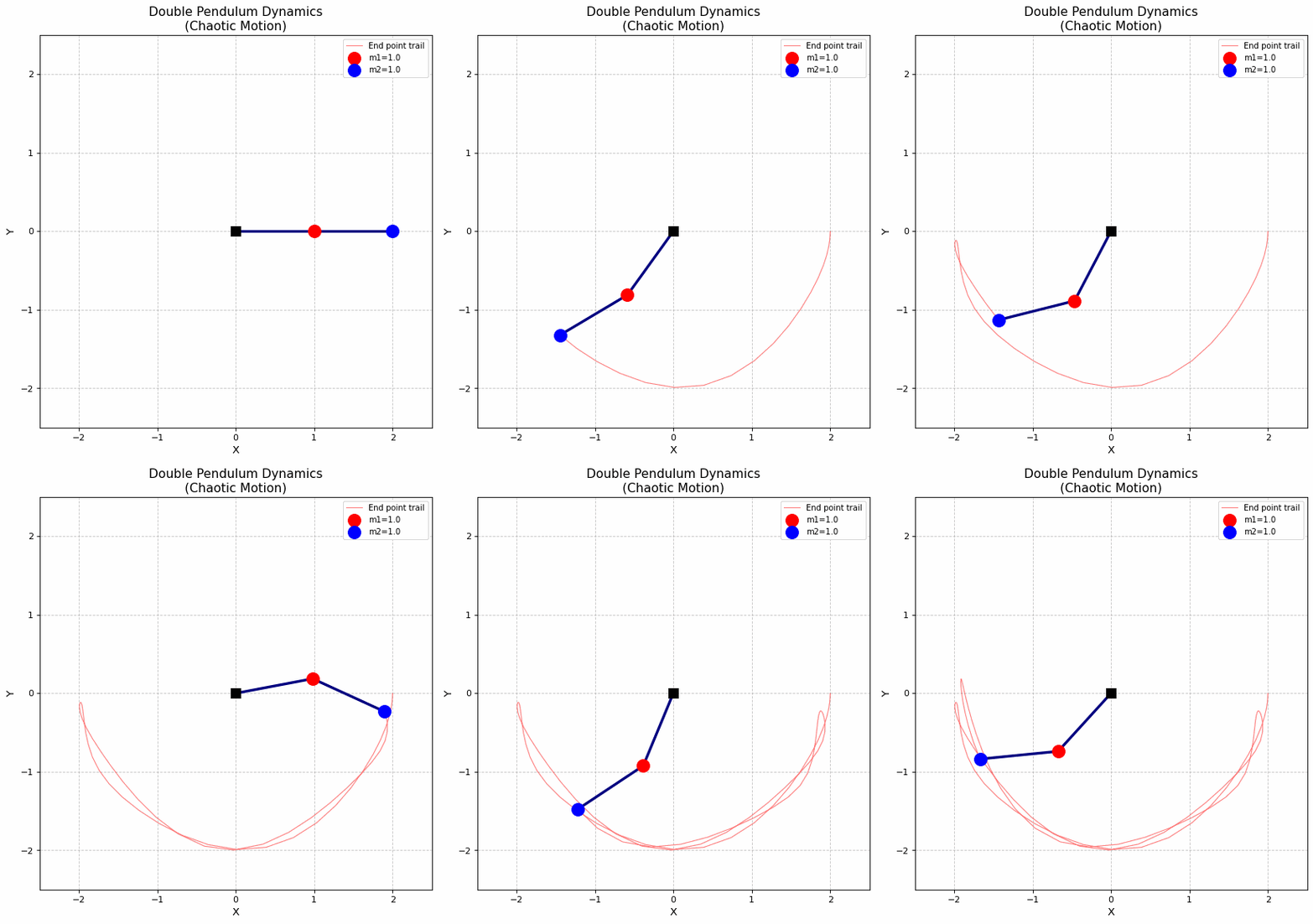
Animation — Watch how forces propagate through a double pendulum:
E. Newton-Euler Recursive Formulation
Mathematical Formulation
The Newton-Euler algorithm computes dynamics recursively using:
Outward Recursion (Base to Tip):
Inward Recursion (Tip to Base):
Where: - \(\omega_i\): Angular velocity of link \(i\) - \(\dot{v}_i\): Linear acceleration of COM of link \(i\) - \(f_i\): Force exerted on link \(i\) by link \(i-1\) - \(\tau_i\): Torque at joint \(i\) - \(r_{i,i-1}\): Vector from joint \(i-1\) to COM of link \(i\)
Code Implementation
import numpy as np

def newton_euler_step(q, qd, qdd, link_params, gravity=9.81):
    """
    Perform one Newton-Euler iteration for an n-link planar robot.

    This implements the recursive Newton-Euler algorithm:
    1. Outward pass: propagate velocities and accelerations
    2. Inward pass: propagate forces and compute torques

    Args:
        q: Joint angles [rad] (n elements)
        qd: Joint velocities [rad/s] (n elements)
        qdd: Joint accelerations [rad/s²] (n elements)
        link_params: List of dicts with keys:
            - 'mass': Link mass [kg]
            - 'length': Link length [m]
            - 'com': Distance from joint to COM [m]
            - 'inertia': Moment of inertia about COM [kg·m²]
        gravity: Gravitational acceleration [m/s²]

    Returns:
        tau: Joint torques [N·m]
    """
    n = len(q)

    # Initialize velocity and acceleration arrays
    omega = np.zeros(n)      # Angular velocities
    omega_dot = np.zeros(n)  # Angular accelerations
    v_dot = np.zeros(n)      # Linear accelerations at COM
    v_dot_prev = np.zeros(n) # Linear accelerations at joint i-1

    # Storage for link properties
    r = np.zeros(n)   # COM positions relative to previous joint
    f = np.zeros(n)   # Forces
    tau = np.zeros(n) # Torques

    # ============== OUTWARD RECURSION ==============
    # Propagate velocities and accelerations from base to tip

    for i in range(n):
        # Angular velocity of link i
        # omega_i = omega_{i-1} + qd_i (revolute joint adds qd_i * z)
        if i == 0:
            omega[i] = qd[i]
        else:
            omega[i] = omega[i-1] + qd[i]

        # Angular acceleration of link i
        # omega_dot_i = omega_dot_{i-1} + qdd_i
        if i == 0:
            omega_dot[i] = qdd[i]
        else:
            omega_dot[i] = omega_dot[i-1] + qdd[i]

        # Position vector from joint i-1 to COM of link i
        # For a uniform rod, COM is at l_i/2 from the joint
        r[i] = link_params[i]['com']

        # Linear acceleration at COM of link i
        # v_dot_i = v_dot_{i-1} + omega_dot_i × r_i + omega_i × (omega_i × r_i)
        # In 2D, cross products become:
        # omega_dot × r = [0, 0, omega_dot] × [r, 0, 0] = [0, omega_dot*r, 0]
        # omega × (omega × r) = -omega² * r (points inward)
        if i == 0:
            v_dot[i] = gravity + omega_dot[i] * r[i] - omega[i]**2 * r[i]
        else:
            # Add contribution from previous link motion
            v_dot[i] = v_dot_prev[i] + omega_dot[i] * r[i] - omega[i]**2 * r[i]

        v_dot_prev[i] = v_dot[i]

    # ============== INWARD RECURSION ==============
    # Propagate forces from tip to base and compute torques

    for i in range(n-1, -1, -1):
        mass = link_params[i]['mass']
        inertia = link_params[i]['inertia']

        # Force on link i from link i+1 (f_{i+1} on link i)
        if i == n-1:
            f_next = np.zeros(2)  # No force from tip
        else:
            f_next = np.array([f[i+1], 0])  # x-component of force

        # Linear acceleration of COM
        a = v_dot[i]

        # Force equation: f_i = f_{i+1} + m_i*v_dot_i - m_i*g
        # In x-y: f_x = f_next_x + m*a_x, f_y = f_next_y + m*(a_y - g)
        f[i] = f_next[0] + mass * a

        # Torque at joint i
        # tau_i = tau_{i+1} + r_i × f_i + I_i*omega_dot_i + omega_i × (I_i*omega_i)
        # In 2D revolute joint, only z-component of torque is nonzero:
        # r × f = r * f_y (in 2D planar motion)
        if i == n-1:
            tau_next = 0  # No torque from tip
        else:
            tau_next = tau[i+1]

        # Coriolis term in 2D: omega × (I*omega) = 0 (since omega is scalar in 2D)
        tau[i] = tau_next + r[i] * f[i] + inertia * omega_dot[i]

    return tau


# Simplified version for 2-link planar robot
def newton_euler_2link(m1, m2, l1, l2, r1, r2, I1, I2,
                        theta1, theta2, qd1, qd2, qdd1, qdd2, g=9.81):
    """
    Newton-Euler for 2-DOF planar robot (explicit formulation).

    This verifies the recursive algorithm by computing the same result
    as the manipulator equation.
    """
    # Link parameters
    link1 = {'mass': m1, 'length': l1, 'com': r1, 'inertia': I1}
    link2 = {'mass': m2, 'length': l2, 'com': r2, 'inertia': I2}

    # Outward recursion
    # Joint 0
    omega0 = qd1
    omega_dot0 = qdd1
    v_dot0 = g + omega_dot0 * r1 - omega0**2 * r1  # v_doti = g + alpha*r - omega²*r

    # Joint 1 (relative to joint 0)
    omega1 = omega0 + qd2
    omega_dot1 = omega_dot0 + qdd2
    # Linear acceleration includes contribution from joint 0 motion
    v_dot1 = v_dot0 + omega_dot1 * r2 - omega1**2 * r2

    # Inward recursion
    # Link 2
    f2 = m2 * v_dot1  # No external force at tip
    tau2 = r2 * f2 + I2 * omega_dot1  # Only link 2 inertia contributes

    # Link 1
    f1 = f2 + m1 * v_dot0  # Add link 1's weight
    tau1 = tau2 + r1 * f1 + I1 * omega_dot0  # Link 1 must support link 2

    return np.array([tau1, tau2])


# Example usage
if __name__ == "__main__":
    # Robot parameters
    m1, m2 = 5.0, 3.0  # kg
    l1, l2 = 1.0, 0.8  # m
    r1, r2 = 0.5, 0.4  # m
    I1, I2 = 0.1, 0.05  # kg·m²

    # State
    theta1, theta2 = np.pi/4, np.pi/6
    qd1, qd2 = 0.5, 0.3
    qdd1, qdd2 = 0.1, 0.2

    # Link parameters for recursive algorithm
    link_params = [
        {'mass': m1, 'length': l1, 'com': r1, 'inertia': I1},
        {'mass': m2, 'length': l2, 'com': r2, 'inertia': I2}
    ]

    # Compute using Newton-Euler
    tau_ne = newton_euler_step([theta1, theta2], [qd1, qd2], [qdd1, qdd2], link_params)
    tau_explicit = newton_euler_2link(m1, m2, l1, l2, r1, r2, I1, I2,
                                       theta1, theta2, qd1, qd2, qdd1, qdd2)

    # Compare with Lagrangian formulation
    tau_lagrangian = compute_manipulator_equation(m1, m2, l1, l2, r1, r2, I1, I2,
                                                  theta1, theta2, qd1, qd2, qdd1, qdd2)

    print("Torque comparison:")
    print(f"  Newton-Euler (recursive): {tau_ne}")
    print(f"  Newton-Euler (explicit):  {tau_explicit}")
    print(f"  Lagrangian:               {tau_lagrangian}")
    print(f"  Match: {np.allclose(tau_ne, tau_lagrangian) and np.allclose(tau_ne, tau_explicit)}")
Code Breakdown
| Phase | Operation | Key Formula |
|---|---|---|
| Outward | Angular velocity | \(\omega_i = \omega_{i-1} + \dot{q}_i\) |
| Outward | Linear acceleration | \(\dot{v}_i = \dot{v}_{i-1} + \dot{\omega}_i r_i - \omega_i^2 r_i\) |
| Inward | Force propagation | \(f_i = f_{i+1} + m_i\dot{v}_i\) |
| Inward | Torque computation | \(\tau_i = \tau_{i+1} + r_i f_i + I_i\dot{\omega}_i\) |
Reference: See the double pendulum animation for visualization of force propagation.
Manipulator Equations of Motion
Where \(N\) represents all nonlinear terms including Coriolis, centrifugal, and gravity effects.
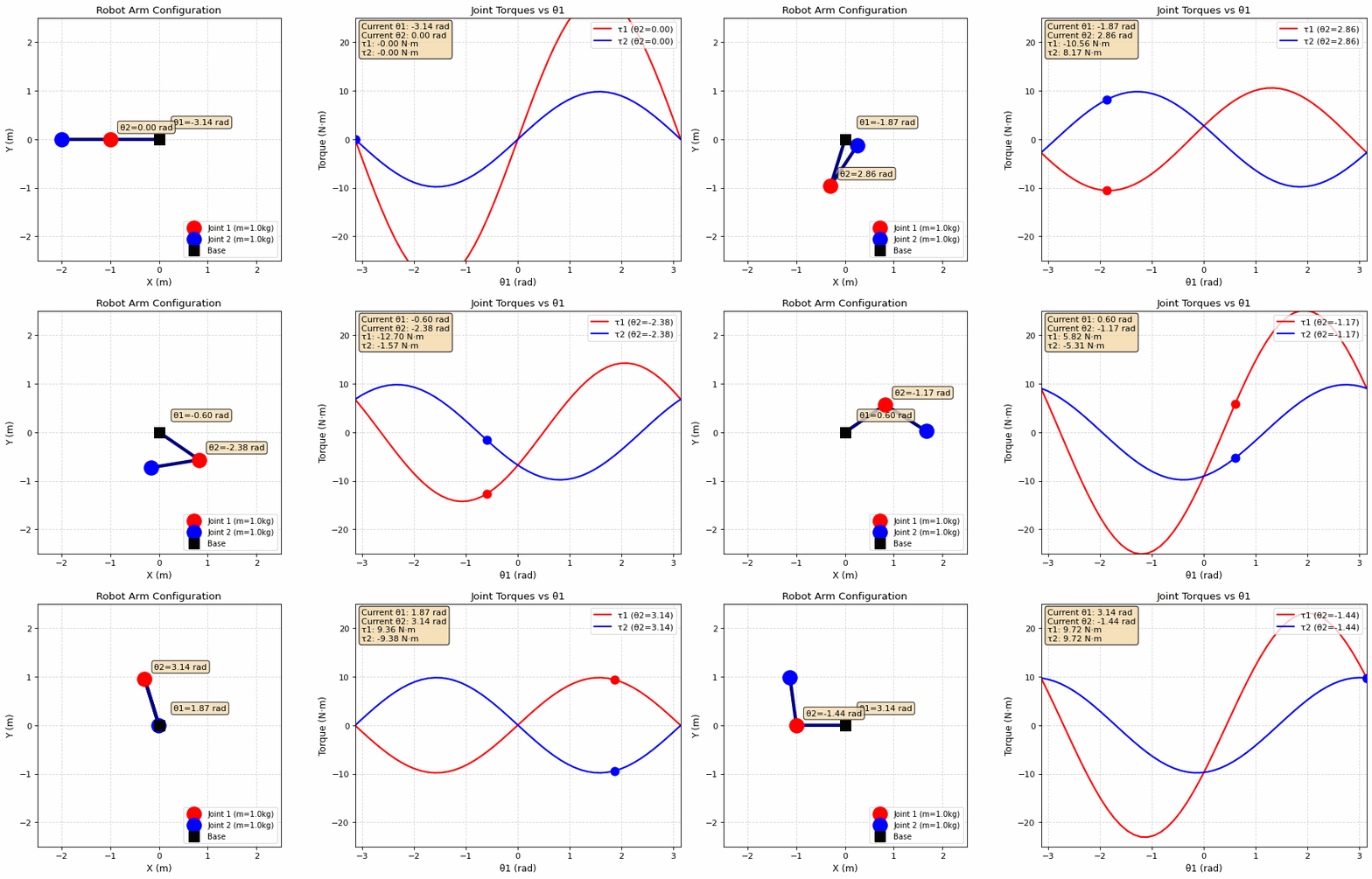
Dynamic Parameters
Key parameters affecting robot dynamics: - Link masses - Moments of inertia - Center of mass locations - Friction coefficients
Animation — Observe how joint torques vary with configuration:
Practical Considerations
Friction Models
- Coulomb friction
- Viscous friction
- Stiction (static + kinetic)
Actuator Dynamics
- Motor constants
- Gear ratios
- Backlash